
In early January 2026, Hilton was pulled into a national political firestorm after a Minnesota franchise denied accommodations to ICE agents. The incident was real, the media coverage was immediate, and the online response was fast-moving. What started as a serious operational crisis was quickly addressed by Hilton, but automated amplification online kept the negative backlash alive and growing.
What Actually Happened
The controversy began on January 5, when the Department of Homeland Security publicly accused a Hilton-affiliated Hampton Inn in Lakeville, Minnesota, of canceling ICE agent reservations after discovering their agency affiliation. Screenshots of hotel emails circulated widely, showing the hotel stating it would not accept immigration enforcement agents as guests.
Hilton responded quickly. The company clarified that the hotel was a franchise and had acted in violation of brand standards. Corporate issued a statement, initiated removal of the hotel from its system, and emphasized that Hilton does not support any form of discrimination.
That statement helped slow some of the boycott chatter and reframed parts of the conversation. But the campaign against Hilton had already found traction — and a different set of dynamics had kicked in.
What the Data Shows: The Incident Was Highly Amplified
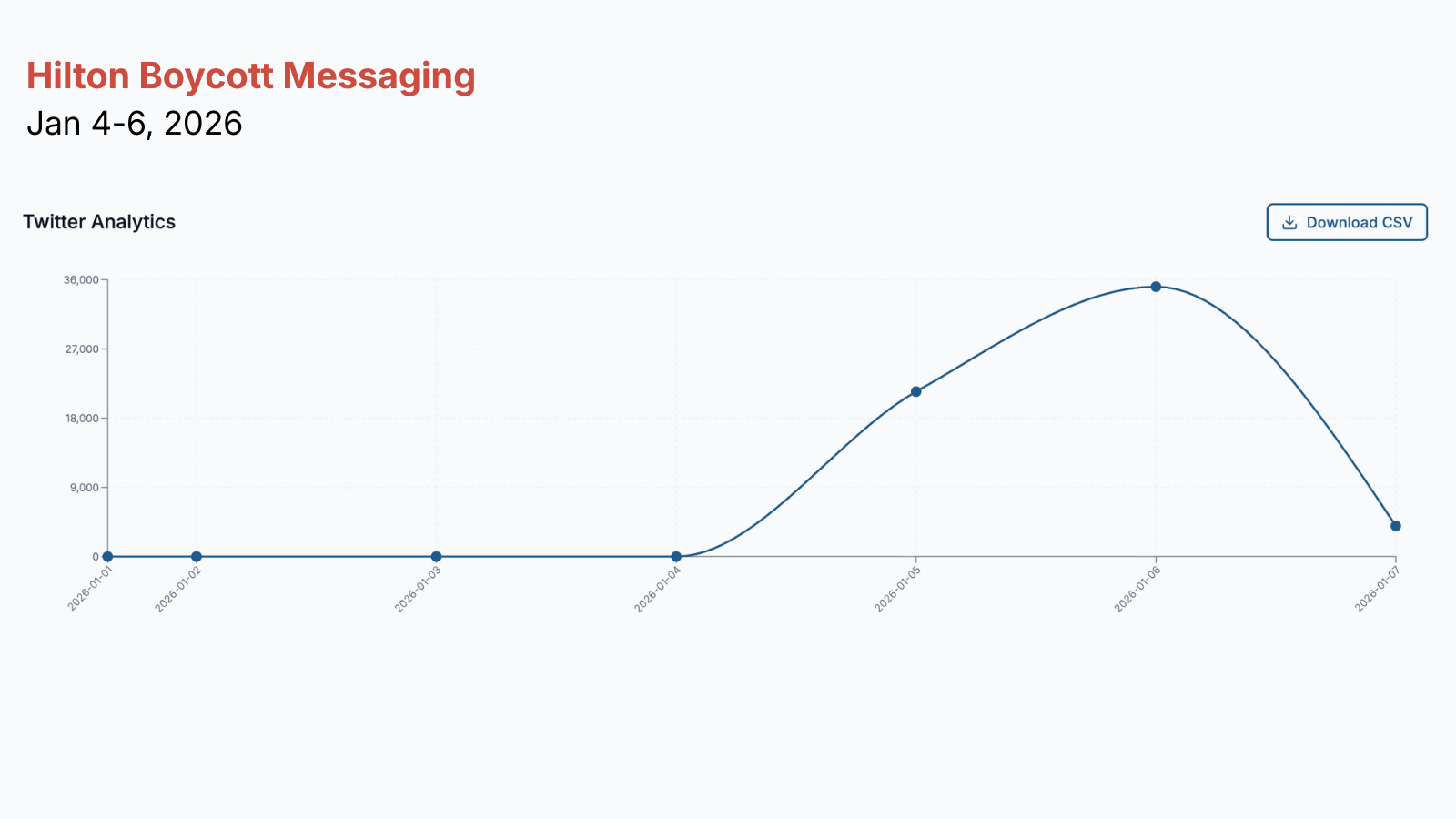
From January 4 to January 6:
Hilton was mentioned roughly 580,000 times on X (formerly Twitter)
283,453 posts connected Hilton to ICE, migrants, “aliens,” or Trump
Over 60,000 posts explicitly called for a boycott
Around 51,540 posts compared Hilton to the Bud Light backlash
Hilton’s response landed quickly, but the controversy kept gaining traction as coordinated messaging continued to drive the conversation.
Nearly 39% of the Hilton Conversation Came From Bots
Bot activity during this period reached 38.6%, far above the standard baseline seen in large brand events. That total includes:
11.7% “Almost Certain” bots
13.7% “Very Likely” bots
13.2% “Likely” bots
These weren’t just random retweets or low-effort engagement. They were part of a strategic campaign using repetitive messaging, centralized templates, and coordinated timing to maximize visibility and pressure.
How the Amplification Worked
Template Messaging
The dominant feature of the campaign was its message discipline. Thousands of accounts posted identical or near-identical phrasing, including:
“BREAKING: Nick Sortor confronted the Minnesota Hilton hotel and exposed…”
“Boycott Hilton!”
“Hilton Hotels cancels reservations for ICE agents!”
“Hilton decided to Bud Light themselves.”
These posts were deployed in synchronized waves across unrelated accounts. Rather than spreading organically through viral engagement or influencer lift, they relied on sheer repetition and volume to flood feeds and trend surfaces.
The Bud Light Comparison
The most consistent narrative frame was the comparison to Bud Light, a conservative-led boycott that inflicted long-term brand damage in 2023–2024. That reference wasn’t incidental. It was a deliberate psychological cue, designed to invoke precedent, activate prior outrage networks, and signal threat credibility.
By invoking a recent example of “successful” corporate punishment, the messaging gave participants a clear playbook, and gave the boycott campaign emotional momentum.
Narrative Structure and Sentiment Breakdown
The amplified discourse broke into five dominant clusters:
Direct boycott calls using simple, imperative language
“Bud Light” comparisons, suggesting Hilton had committed irreversible brand suicide
Pro-ICE accounts framing Hilton as anti-ICE
Franchise vs. corporate debate, with minimal traction
Counter-narratives, mostly progressive, defending the hotel — largely drowned out
Sentiment within the bot-amplified content was overwhelmingly negative:
92% negative
6% neutral
1% positive (mostly limited to progressive praise)
This skew shows how the amplification didn’t just increase volume, it flooded the platform with a highly disciplined, one-sided narrative.
Why This Matters
The Hilton–ICE controversy is a clear example of how modern backlash operates in two layers:
The surface layer: a real, localized incident that triggered attention and concern
The infrastructure layer: a coordinated effort to escalate that incident into a broader ideological battle
Hilton’s swift response likely helped limit long-term damage. But the intensity and structure of the backlash, driven in part by bot activity, message repetition, and strategic framing, show how vulnerable even fast-moving brands are to amplification campaigns.
This wasn’t just about one hotel. It became about Hilton’s perceived politics, corporate values, and identity. And that shift wasn’t entirely organic.
Key Takeaways for Brands
Speed helps, but doesn’t always control the narrative. Hilton’s fast statement helped slow escalation, but couldn’t fully counter the momentum of coordinated messaging.
Coordinated backlash looks different from viral criticism. Look for synchronized posts, high repetition, and ideological hooks like “Bud Light” to spot the difference.
Sentiment skews are often manufactured. When bot-driven content dominates, public perception can quickly distort beyond reality.
In a polarized media landscape, the question isn’t whether backlash is real. It’s how much of it is real, and how much is being engineered.
To learn more about PeakMetrics’s bot detection, request a demo.