
The FDA walked back its initial Cyclospora finding tied to Taylor Farms, and the online conversation moved with it, just not in the direction food safety teams might expect. Rather than settling, discussion shifted toward an unsubstantiated theory that a reported $1 million Taylor Farms donation to MAGA Inc., or an alleged visit by CEO Bruce Taylor to the White House, influenced the FDA’s reversal. The FDA has not cleared Taylor Farms and continues to investigate. What changed is the story people are telling.
Using PeakMetrics Smart Categories, our AI-powered classifier that organizes conversations into the narratives, tones, and signals that matter most, we analyzed Taylor Farms and Taco Bell conversations across social media over the past two weeks. That let us isolate the conspiracy narrative from the underlying food safety story, measure sentiment and bot activity within each, and track how blame attribution moved as the story evolved.
In the 24 hours following the FDA’s reversal:
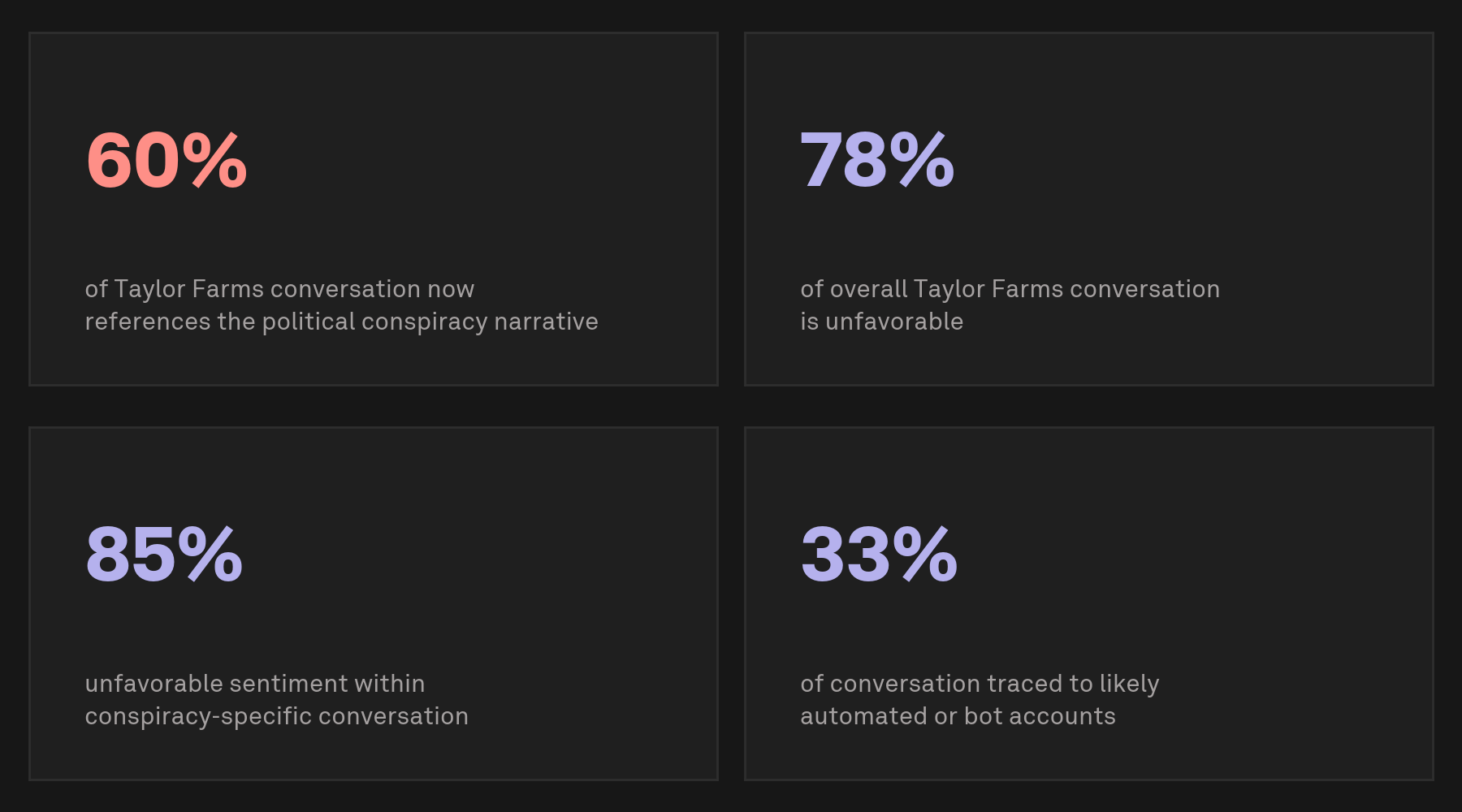
60% of all Taylor Farms conversation now references or amplifies the political conspiracy narrative
78% of overall Taylor Farms conversation is unfavorable
85% unfavorable sentiment within conspiracy-specific conversation
33% of conversation traced to likely automated or bot accounts
The crisis quickly became political
Within a day of the FDA’s announcement, the conspiracy narrative overtook the food safety investigation itself to become the dominant storyline. Conversation is no longer centered on contaminated produce or investigation details — it has moved to questions of political influence, regulatory integrity, and favoritism.
Automation accelerated the narrative
Approximately one-third of the Taylor Farms conversation came from likely automated or bot accounts, helping accelerate the scale and visibility of the discussion.
While a one-third bot share is relatively common during high-profile brand crises, it highlights how quickly automated amplification can help push a new narrative into the mainstream.
The disputed apology
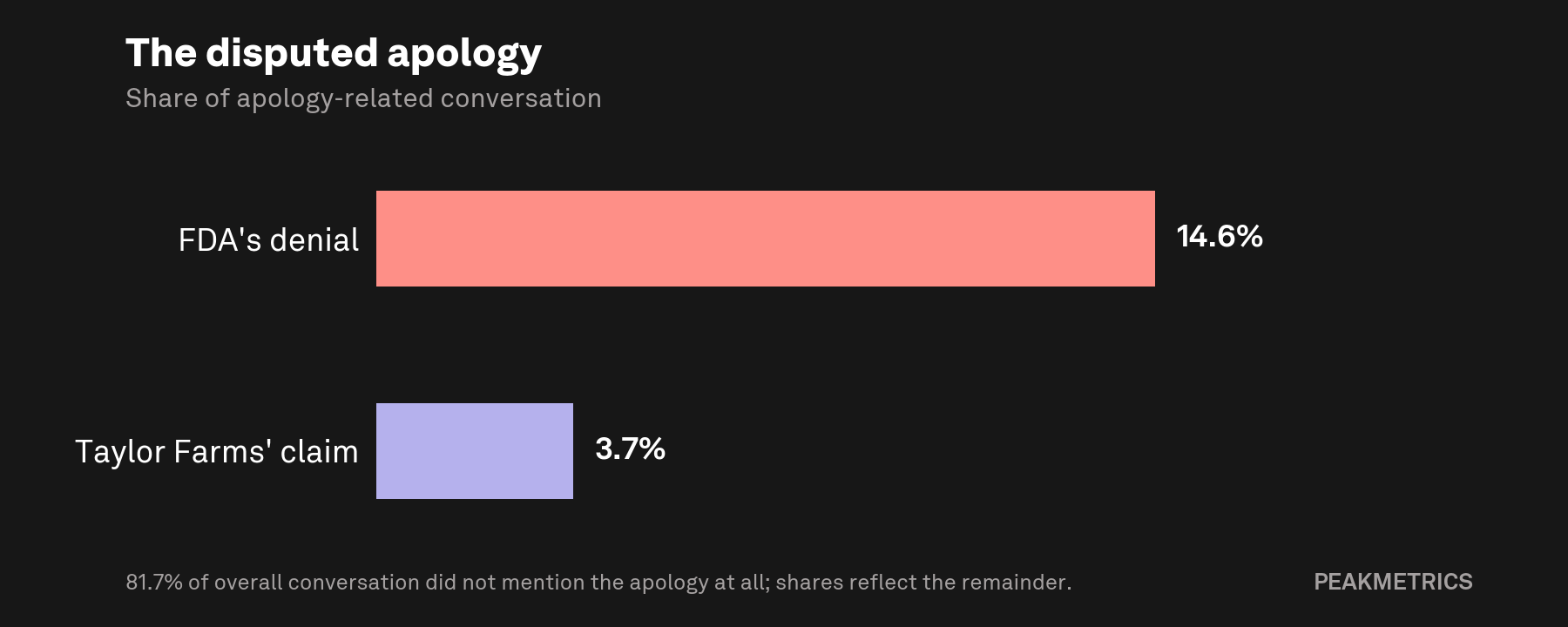
The FDA’s public denial that it apologized to Taylor Farms generated significantly more discussion than Taylor Farms’ original claim that an apology had been issued — a reversal of the pattern communications teams usually expect, where initial claims tend to travel farther than later corrections.
The narrative didn’t stay contained
Because of its supplier relationship with Taylor Farms, Taco Bell has increasingly been pulled into the conversation. Overall sentiment toward Taco Bell remains less negative than toward Taylor Farms — 49.1% unfavorable, 42.9% neutral, 7.9% favorable — but roughly 25% of all outbreak-related Taco Bell conversation now references the broader Taylor Farms political conspiracy narrative.
Blame has shifted dramatically
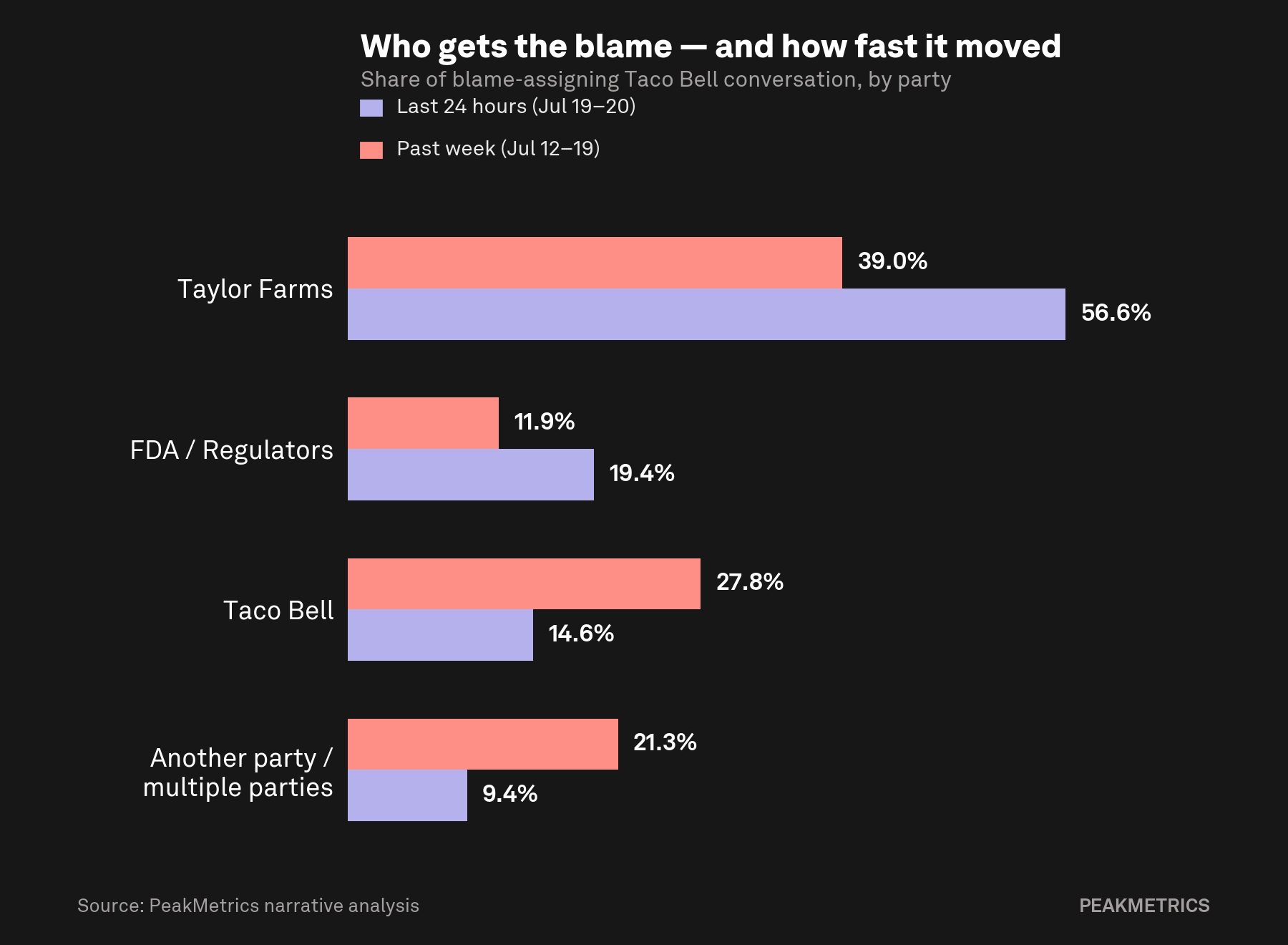
Among the Taco Bell/parasite conversations that explicitly assign blame, the distribution has moved considerably over the course of a week.
Last 24 hours (July 19–20):
Taylor Farms — 56.6%
FDA/regulators — 19.4%
Taco Bell — 14.6%
Another party — 9.4%
Past week (July 12–19):
Taylor Farms — 39.0%
Taco Bell — 27.8%
Another party — 21.3%
FDA/regulators — 11.9%
Blame directed at Taylor Farms grew substantially while blame toward Taco Bell fell by nearly half. Criticism of regulators also grew as allegations about the FDA’s reversal became more central to the conversation.
A growing pattern in modern brand crises
Taylor Farms is the latest example of a broader pattern we’re tracking across high-profile brand crises: once a story intersects with politics, conversation moves past the underlying event and toward ideological narratives.
For communications teams, this changes the job. Responding to the original issue is no longer enough once public conversation has already moved on. Teams also need visibility into how narratives are evolving, who is amplifying them, and whether new storylines are beginning to reshape perception. Understanding when a narrative changes may matter as much as understanding why the crisis began.
What else is new
How Election Fraud Narratives Nearly Doubled After the Los Angeles Mayoral Race — unsubstantiated election fraud claims went from 23.3% of classified conversation before the race to 44.9% after results were announced — driven almost entirely by domestic political communities.
PeakMetrics Recognized as a Pace Setter in the 2026 Gartner® Inaugural Emerging Market Quadrant for Narrative Intelligence — Gartner named narrative intelligence its own emerging market and recognized PeakMetrics as a Pace Setter among startup vendors.
As Turnaround Questions Mount, Is the World Cup Changing the Conversation Around Nike? — despite weeks of tough earnings headlines, online conversation about Nike stayed largely positive as the FIFA World Cup shifted attention toward culture and product.